Walk through any fastener production facility running at volume and you will find the same pressure point: the slot. A bolt head slot that is 0.05 mm off on depth gets rejected. A screw slot with rough side walls fails downstream inspection. And when you are producing thousands of pieces per shift, one unreliable cutter can quietly ruin an entire production run before anyone catches it.
This is exactly why carbide slitting cutters for bolt slotting have become the standard in serious fastener production not because carbide is trendy, but because the tolerance window in bolt slotting is narrow, the volumes are high, and HSS tools simply cannot sustain the edge consistency that high-speed slotting cutter for fastener manufacturing demands. This guide covers what matters: specifications, applications, machining parameters, and how to select the right carbide slitting cutter for bolt slotting for your specific operation.
Why Carbide Wins in Bolt Slotting Applications
The case for solid carbide in bolt slotting comes down to three things: hardness, heat tolerance, and edge consistency over time. Solid tungsten carbide sits at HRA 89–93, versus HSS at HRC 62–65. That hardness advantage is what lets a solid carbide slitting saw for bolt slotting maintain its edge geometry across thousands of pieces where an HSS equivalent has already begun to drift.
Heat tolerance matters because even at moderate bolt slotting speeds, cutting temperatures in stainless and alloy steels regularly exceed 600°C the point at which HSS begins to soften. Carbide remains stable well beyond that threshold, which means carbide tool wear resistance holds through shifts where an HSS tool would need multiple changeovers. The economics follow: a solid carbide slitting cutter typically outlasts HSS by a factor of five to ten, and the cost per part produced is significantly lower despite the higher unit cost.
In high-volume bolt slotting, the cutter is the most controllable variable in the tolerance equation. Everything else machine, fixturing, coolant amplifies what the cutter can or cannot do.
For fastener manufacturing specifically, the shift to solid carbide is not really optional at competitive production volumes. It is the baseline.
Specifications: What Each Number on the Datasheet Actually Means
Understanding a carbide cutter for screw head slotting datasheet is not complicated, but each parameter has a direct performance consequence. Here is what to look at and why it matters for your bolt slotting operation.
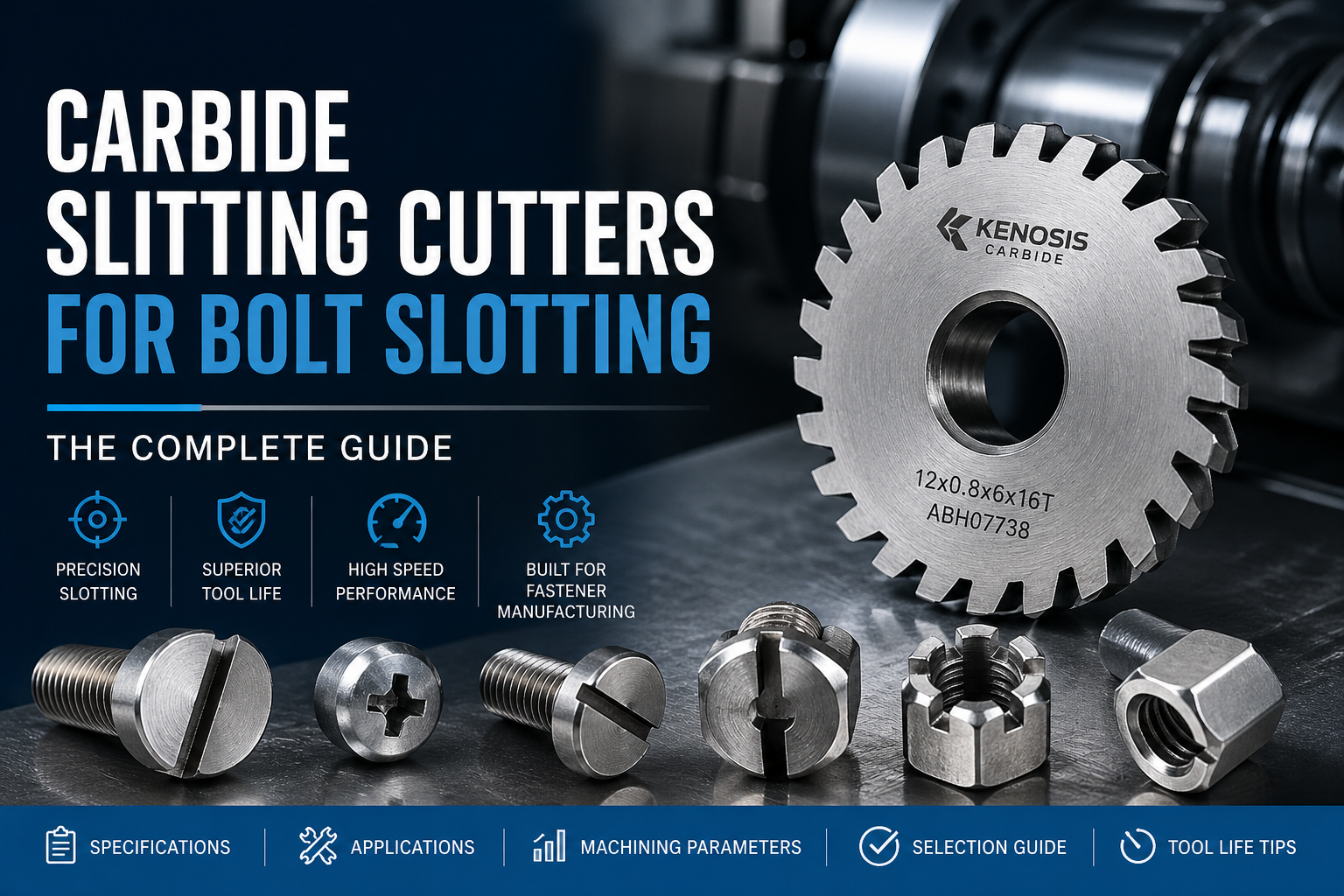
Outer Diameter (OD) determines cutting reach and centrifugal behaviour at speed. For most bolt and screw head slotting, ODs in the 10–25 mm range are standard. Kenosis Carbide’s standard slitting cutter runs a 12 mm OD right in the sweet spot for the majority of fastener head profiles.
Thickness is the slot width. It has to match your required slot dimension with enough tolerance left over for thermal expansion at operating temperature. At 0.8 mm, the Kenosis standard covers the most common slotted fastener profiles.
Number of Teeth affects chip load and surface finish. More teeth means finer finish and lower chip load per tooth better for harder materials. The 16-tooth configuration on the Kenosis slotting cutter for fastener manufacturing is balanced for the stainless and alloy steels most common in production environments.
Full specifications for reference:
| Specification | Value |
| Product Code | ABH07735 / ABH07738 / ABH07741 |
| Outer Diameter (OD) | 12 mm |
| Inner Diameter (ID) | 6 mm |
| Thickness | 0.8 mm |
| Number of Teeth | 16 |
| Material | Solid tungsten carbide |
| Application | Bolt slotting, screw head slotting, nut processing |
Table 1: Kenosis Carbide slitting cutter standard specifications Product Codes ABH07735, ABH07738, ABH07741
Applications in the Fasteners Industry
The phrase ‘carbide slitting cutters for bolt slotting’ covers more ground than most people assume. The same tool category applies across several distinct fastener operations:
• Straight slotted bolt and screw heads: the most common application. Requires consistent thickness control and depth repeatability. A carbide cutter for screw head slotting that drifts even 0.03 mm in width produces driver engagement problems downstream.
• Phillips and Pozidriv profiles: two intersecting slots at 90 degrees. Tighter geometry tolerances than straight slots, particularly on depth, since the cross profile relies on geometry for torque transfer.
• Nut slotting: castle nuts, slotted hex nuts, and similar fasteners. A precision carbide cutter for nut slotting running on nut stock needs the same edge consistency as bolt slotting, but the fixturing dynamics are different.
• Custom aerospace and automotive profiles : non-standard recesses and speciality slot geometries that fall outside catalogue ranges. These require engineered-to-order tooling rather than standard products.
Whether it is a standard slotted bolt at volume or a custom aerospace fastener with an unusual recess geometry, the cutter has to match the application exactly. Close enough in bolt slotting is not good enough.
Machining Parameters: Slitting Saw RPM, Feed Rate, and Coolant
Getting the right slitting saw RPM feed rate is where a large portion of tool life is won or lost. Carbide allows significantly higher cutting speeds than HSS, but running too fast without adequate coolant generates heat that causes edge micro-fracture over time. Running too slow wastes the performance advantage of carbide without protecting the tool.
Starting parameters by material:
| Material | RPM Range | Feed Rate (mm/rev) | Coolant |
| Mild Steel | 3,000–5,000 | 0.02–0.05 | Soluble oil |
| Stainless Steel | 1,500–3,000 | 0.01–0.03 | High-pressure |
| Brass / Copper | 5,000–8,000 | 0.04–0.08 | Dry / mist |
| Aluminium | 8,000–12,000 | 0.05–0.10 | Dry / air |
| Hardened Steel | 800–1,500 | 0.008–0.02 | Flood coolant |
Table 2: Recommended machining parameters for Kenosis Carbide slitting cutters by workpiece material
These are starting points; actual optimal parameters depend on your machine rigidity, workholding, and coolant delivery. Start conservatively, measure surface finish and tool wear, then adjust. On bolt head slot depth tolerance: check your Z-axis repeatability before blaming the cutter for depth variation. Thermal drift in the machine structure is a more common culprit than most production engineers expect.
For stainless steel and hardened materials, high-pressure coolant is not optional. It is the difference between predictable tool life and random failure. For aluminium and brass, dry machining or compressed air is often preferable some cutting fluids react with non-ferrous materials and leave residues that cause downstream finishing problems.
Choosing the Right Carbide Slitting Cutter: A Practical Framework
Selecting the right carbide slitting cutter for bolt slotting comes down to four questions answered in order:
What is the slot geometry? Drawing first, always. Width, depth, and profile determine cutter thickness, OD, and tooth geometry. No tooling expertise compensates for an undefined spec.
What is the workpiece material? Material drives grade selection, coating recommendation, and machining parameters. Mild steel, stainless, aluminium, and hardened alloys all require different approaches to slotting cutter for fastener manufacturing specifications.
What are the production volumes? High volume means tool life matters more than unit cost. At 50,000 bolts per shift, a cutter that lasts twice as long halves your changeover frequency. The economics of carbide slitting cutters for fasteners almost always favour the higher-quality tool at production scale.
Standard or custom? For most standard fastener profiles – slotted bolt heads, Phillips screws, and slotted hex nuts – Kenosis Carbide’s standard product range covers the requirement. For non-standard profiles, bore sizes, or material combinations, their customised cutter programme handles these with engineered-to-order tooling rather than catalogue adaptations.
Extending Tool Life: What Works in Practice
Carbide cutter regrinding is the most cost-effective tool life extension available. Solid carbide slitting cutters can be reground three to five times before the geometry becomes too compromised to hold tolerance. The critical practice: inspect on piece count intervals, not just when problems appear. Catch wear before it goes past the optimal regrind point, and you recover multiple additional regrind cycles from each tool.
Storage matters more than most shops acknowledge. Carbide chips from contact with other tools during storage. Individual sleeves or compartmented tooling trays are not optional; they are basic tool life management. And check runout every time a cutter is mounted. A small burr on the arbor introduces runout that accelerates edge wear faster than any machining parameter error.
For high-volume bolt production tooling environments, a structured tool life tracking programme recording piece count per cutter, regrind cycle, and dimensional measurements at each regrind pays for itself quickly in reduced scrap and fewer unexpected production stops.
Frequently Asked Questions
Can carbide slitting cutters be reground?
Yes. A quality solid carbide slitting cutter can be reground three to five times with the right diamond grinding wheel and proper technique. Each regrind reduces OD slightly, so track dimensions and retire tools before they fall outside tolerance.
What is the difference between standard and custom bolt slotting cutters?
Standard carbide slitting cutters for bolt slotting cover the most common fastener profiles and machine bore sizes. Custom tooling is needed when slot geometry, bore, material, or performance requirements fall outside the standard range. Kenosis Carbide’s customised programme handles these from drawing or specification.
Why does my slot width vary across a production run?
The most common cause is spindle runout, not cutter quality. Check arbor cleanliness and spindle condition first. Thermal expansion of the cutter during extended runs can also cause minor dimensional shifts worth checking if the width drifts consistently in one direction from start to end of shift.
Conclusion
Precision in bolt slotting is not accidental. It is the result of matching the right carbide slitting cutters for bolt slotting to the right material, running it at the right parameters, and maintaining it properly across its useful life. Carbide slitting cutters for fasteners are the foundation of that precision, not because of what they cost, but because of what they consistently deliver at production volume. Kenosis Carbide manufactures standard and custom carbide slitting cutters for the fastener industry from their facility in Rajkot, Gujarat. Their engineering team engages directly from the first enquiry for both standard product and customised tooling requirements.